
 Vivek Raman
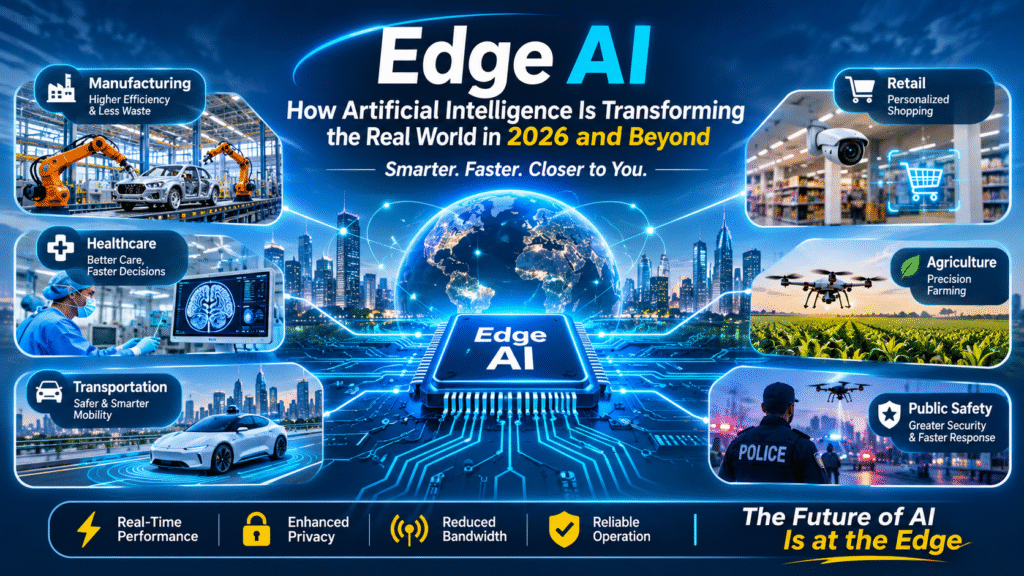
Artificial Intelligence (AI) is becoming an important part of our everyday lives. From smartphones and smart cars to hospitals and factories, AI is helping people work faster, make better decisions, and solve real-world problems.
One of the most exciting developments in this field is Edge AI.
Edge AI means running artificial intelligence directly on devices such as cameras, sensors, smartphones, robots, and machines instead of sending all the data to cloud servers for processing.
In simple words, Edge AI brings intelligence closer to where the data is created. This allows devices to make decisions quickly, work without a constant internet connection, and protect sensitive information.
As we move toward 2026 and beyond, Edge AI is expected to transform many industries, including manufacturing, healthcare, transportation, agriculture, retail, and public safety.
1. What Is Edge AI?
Normally, AI systems send information to cloud servers, process it there, and send the results back to the device. This process requires an internet connection and can sometimes cause delays.
Edge AI works differently. It processes information directly on or near the device where the data is collected. For example, a smart security camera with Edge AI can identify unusual activity immediately without sending every video recording to the cloud.
Key benefits of Edge AI:
- Faster responses: Devices can make decisions almost instantly.
- Better privacy: Sensitive information can stay on the local device.
- Less internet usage: There is no need to continuously upload large amounts of data.
- Reliable operation: Devices can continue working even when internet connectivity is unavailable.
- Lower operating costs: Local processing can reduce cloud computing and data-transfer expenses.
In simple terms, Edge AI is AI working in the real world, right where it is needed.
2. Industries That Will Be Transformed by Edge AI
Edge AI has the potential to improve how many industries operate. Let’s look at some important examples.
2.1 Manufacturing: Smarter Factories
Manufacturing companies can use Edge AI to make factories safer, faster, and more efficient.
Some important applications include:
- Real-time quality inspection: AI-powered cameras can identify damaged or defective products during production.
- Predictive maintenance: Smart sensors can monitor machines and predict possible failures before they happen.
- Worker safety: Cameras can detect unsafe working conditions and alert employees immediately.
For example, if a machine starts showing signs of a possible failure, Edge AI can alert the maintenance team before the machine stops working.
Real-world benefit: Less production waste, fewer accidents, and reduced downtime.
2.2 Mobility: Smarter and Safer Vehicles
Edge AI plays an important role in the future of transportation.
Self-driving vehicles need to make decisions quickly. They cannot always wait for information from cloud servers.
Edge AI helps vehicles:
- Recognize pedestrians, traffic signals, and other vehicles.
- Apply emergency braking when necessary.
- Monitor driver attention and detect tiredness.
- Operate in areas with limited internet connectivity.
- Provide personalized in-car experiences.
For example, when a pedestrian suddenly crosses the road, an AI-powered vehicle can process the camera and sensor information locally and respond quickly.
Real-world benefit: Improved road safety, faster decisions, and smarter transportation.
2.3 Retail: Better Shopping Experiences
Retail businesses can use Edge AI to improve customer experiences and manage their stores more effectively.
Some applications include:
- Smart inventory management: Cameras can identify empty shelves and low-stock products.
- Loss prevention: AI systems can identify unusual activities around checkout areas.
- Personalized shopping: Digital displays can show relevant promotions based on customer interactions.
- Faster checkout: Smart systems can help automate product recognition and payment processes.
For example, when a product is running low on a shelf, an AI-powered camera can immediately notify store employees.
Real-world benefit: Better customer service, improved inventory management, and reduced business costs.
2.4 Food Service: Faster Restaurants and Better Accuracy
Restaurants and quick-service food businesses can use Edge AI to improve kitchen operations and customer service.
Examples include:
- Checking whether customer orders contain the correct items.
- Monitoring ovens, refrigerators, and fryers.
- Predicting equipment problems before breakdowns occur.
- Identifying delays in kitchen operations.
- Improving order preparation and delivery times.
For example, an AI camera can check whether a burger order includes all the required items before it is handed to the customer.
Real-world benefit: Faster service, fewer order mistakes, and better food quality.
2.5 Agriculture: Smarter Farming
Agriculture is another industry where Edge AI can make a major difference.
Farmers can use drones, cameras, sensors, and smart farming equipment to monitor their fields.
Some applications include:
- Detecting crop diseases and pests.
- Monitoring soil conditions and crop health.
- Providing information about watering and fertilizer requirements.
- Supporting autonomous tractors and harvesting machines.
- Monitoring livestock health through wearable sensors.
For example, a drone with Edge AI can identify unhealthy plants and help farmers take action before the problem spreads.
Real-world benefit: Better crop production, reduced resource waste, and more efficient farming.
2.6 Public Safety and Defense: Faster Decisions
Public safety organizations and defense teams often work in challenging environments where internet access may be limited.
Edge AI can help by:
- Analyzing information from body cameras and other sensors.
- Supporting disaster response and rescue operations.
- Detecting potential safety threats.
- Providing real-time information to field personnel.
- Supporting operations in remote locations.
For example, during a natural disaster, drones equipped with Edge AI can analyze images locally and help rescue teams identify areas where people may need assistance.
Real-world benefit: Faster emergency responses, improved safety, and reliable operations in remote environments.
2.7 Healthcare and Medical Technology: Smarter Patient Care
Healthcare is one of the most promising areas for Edge AI because medical decisions often require speed, accuracy, and privacy.
Some important applications include:
- Surgical assistance: AI systems can analyze medical images during surgery and help doctors identify important structures.
- Glucose monitoring: Smart wearable devices can monitor glucose levels and provide predictive alerts.
- Portable ultrasound: AI-powered ultrasound devices can help medical professionals examine patients in rural areas.
- Seizure monitoring: Wearable or implantable systems can analyze brain activity and identify patterns that may indicate an upcoming seizure.
For example, a portable ultrasound device with Edge AI can help doctors examine patients in remote clinics without requiring a continuous internet connection.
Real-world benefit: Faster medical support, improved patient monitoring, and better access to healthcare.
Note: These are potential and developing applications. Medical AI systems require appropriate clinical validation and safety oversight before being used for patient care.
3. Edge AI vs. Cloud AI: What Is the Difference?
Both Edge AI and Cloud AI are useful, but they work in different ways.
| Feature | Edge AI | Cloud AI |
|---|---|---|
| Processing | On local devices | On cloud servers |
| Speed | Usually faster response | Depends on network |
| Internet | Can work offline | Usually needs connectivity |
| Privacy | Data can stay local | Data may be sent to cloud |
| Best use | Real-time decisions | Large-scale data processing |
The two technologies can also work together. Edge AI can handle immediate decisions, while cloud AI can support long-term data storage, model training, and deeper analysis.
4. Challenges of Edge AI
Although Edge AI offers many benefits, organizations also face some challenges when implementing it.
Hardware limitations: Small devices may have limited memory, processing power, and battery capacity.
Security risks: Edge devices can be physically accessed or attacked, so they need strong security protection.
Development costs: Building and maintaining AI-powered devices can require investment in hardware, software, and skilled professionals.
Model accuracy: AI models must be carefully tested to make sure they provide reliable results in real-world situations.
Maintenance and updates: Devices need regular software updates and monitoring to remain secure and accurate.
Companies must address these challenges to build reliable and responsible Edge AI solutions.
5. The Future of Edge AI in 2026 and Beyond
The future of Edge AI is not limited to computers and smartphones. It is moving into the physical world through robots, smart machines, vehicles, wearable devices, and intelligent sensors.
Some important developments to watch include:
- Physical AI: Intelligent machines and robots that can understand and interact with the real world.
- TinyML: Small machine-learning models that run on low-power devices such as sensors and microcontrollers.
- Smart cities: AI-powered traffic systems, public safety monitoring, and intelligent infrastructure.
- Connected healthcare: Wearable devices that monitor patients and provide early warnings.
- Autonomous robotics: Robots that can understand their surroundings and perform tasks with less human intervention.
- Industrial automation: Factories that use AI to improve production, safety, and maintenance.
As hardware becomes more powerful and AI models become more efficient, Edge AI will become increasingly accessible to businesses and individuals.
Edge AI Is Bringing Intelligence into Everyday Life
Edge AI is an important development in the future of artificial intelligence. Instead of depending completely on cloud servers, devices can process information locally and make decisions when and where they are needed. From smart factories and autonomous vehicles to healthcare devices and modern agriculture, Edge AI is creating new opportunities to solve real-world problems.
Its biggest advantages are faster responses, improved privacy, reduced internet usage, and reliable operation.
As we move toward 2026 and beyond, Edge AI will help connect artificial intelligence with the physical world. It is not just about making computers smarter; it is about making everyday machines, devices, and industries more intelligent.
The future of AI is not only in the cloud. It is also at the edge, where intelligence meets the real world.
REFERENCES AND FURTHER READING
- IBM – What Is Edge AI?
- EDGE AI FOUNDATION – Official Website
- EDGE AI FOUNDATION – Edge AI Solutions
- MathWorks – A Practical Introduction to Edge AI



GIPHY App Key not set. Please check settings