
 Vivek Raman
Imagine This…
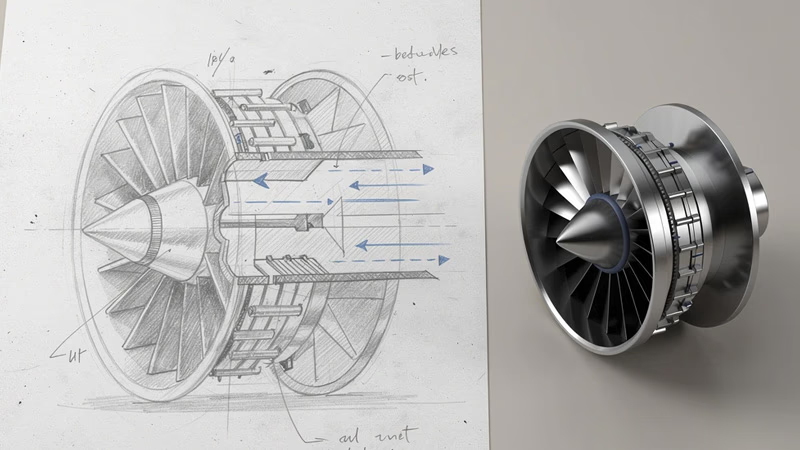
Imagine drawing a simple sketch of a car part on paper. Instead of spending hours rebuilding that sketch inside complex Computer-Aided Design (CAD) software, an intelligent AI system instantly converts it into a detailed 3D model ready for testing, simulation, or even 3D printing.
This futuristic workflow is becoming a reality thanks to researchers at the Massachusetts Institute of Technology (MIT), who have developed a groundbreaking framework called GIFT (Geometric Inference Feedback Tuning). Their research has the potential to revolutionize how engineers, designers, architects, and manufacturers create products.
Rather than replacing engineers, this technology acts as an intelligent assistant that learns from its own mistakes and continuously improves the quality of the designs it produces.
Why Is This Research Important?
Every modern product begins with a digital design.
Whether engineers are creating:
- ✈️ Aircraft components
- 🚗 Automobile parts
- 📱 Consumer electronics
- 🏠 Home appliances
- 🏥 Medical devices
they first build a CAD (Computer-Aided Design) model.
A CAD model is much more than a picture. It contains precise dimensions, mathematical geometry, and engineering instructions that allow manufacturers to produce real products.
Before manufacturing begins, engineers use CAD software to perform virtual tests such as:
- Crash simulations
- Stress analysis
- Heat resistance testing
- Durability analysis
- Aerodynamic simulations
Creating these CAD models manually requires significant time and expertise.
This is where Artificial Intelligence can dramatically accelerate product development.
The Challenge with Existing AI
Today’s Vision-Language Models (VLMs) can understand images and text remarkably well.
For example, they can look at a picture of a mechanical object and generate code that attempts to recreate it.
However, there is one major problem.
Generating perfect CAD code is extremely difficult.
Even a tiny programming mistake can prevent the entire 3D model from being created.
Researchers found that most AI systems can produce code that is almost correct, but “almost” is not enough for engineering.
One small error can make the model unusable.
Introducing GIFT
The MIT research team created a new framework called Geometric Inference Feedback Tuning (GIFT).
Unlike traditional AI training methods, GIFT does something very clever.
Instead of relying only on massive human-created datasets, it allows the AI to learn from its own mistakes.
This means the system continuously becomes smarter without requiring engineers to manually create thousands of additional training examples.
How Does GIFT Work?
The process can be explained in five simple steps.
Step 1: AI Receives a 2D Design
The system begins with:
- a drawing
- an image
- or a design accompanied by text.
Step 2: AI Creates Multiple CAD Programs
Instead of generating only one answer, GIFT asks the AI to create many possible CAD programs simultaneously.
For example, it may generate ten different solutions.
Step 3: GIFT Evaluates Every Solution
The framework checks whether each generated CAD program can actually run correctly.
Some programs work perfectly.
Some are completely wrong.
Many are nearly correct.
Step 4: Learning from Near-Misses
This is where GIFT becomes unique.
Instead of discarding almost-correct answers, it repairs them.
Those corrected examples become valuable new training data.
Rather than saying,
“You failed.”
the system says,
“You were close. Here’s how to fix it.”
Step 5: AI Improves Itself
The corrected solutions are added back into the training dataset.
As the cycle repeats, the AI gradually becomes more accurate and reliable.
This entire process happens automatically without requiring human engineers to manually label new data.
Why Is This Better Than Traditional AI Training?
Traditional AI systems require enormous datasets created by human experts.
Collecting engineering datasets is:
- expensive
- time-consuming
- difficult
- often limited by intellectual property restrictions.
GIFT solves this problem by allowing AI to generate much of its own learning material.
The researchers call this model-aware data augmentation, because the training data is specifically designed around the model’s own weaknesses.
Instead of creating random variations, GIFT generates examples that directly help the AI overcome its mistakes.
Faster and More Efficient
One of the most impressive findings from the research is computational efficiency.
Compared to competing approaches:
- GIFT generated more accurate CAD programs.
- It required only about 20% of the computational power used by many existing techniques.
- The resulting 3D models more closely matched the correct engineering designs.
This means companies could reduce both computing costs and development time.
Real-World Applications
The impact of GIFT extends across many industries.
Automotive Engineering
Designers could quickly transform concept sketches into fully testable vehicle components.
Aerospace
Aircraft manufacturers could generate and evaluate multiple wing or engine designs much faster.
Product Design
Companies could rapidly prototype consumer products before investing in physical manufacturing.
Medical Engineering
Customized implants and medical devices could be designed more efficiently.
3D Printing
Designs could move from concept to printable models in significantly less time.
Learning Without Human Corrections
Perhaps the most exciting aspect of this research is that the system improves itself.
Most AI systems depend on humans to correct mistakes.
GIFT instead uses intelligent feedback to repair its own errors and convert failures into learning opportunities.
This resembles how humans improve skills through practice and reflection.
Looking Ahead
The researchers believe this is only the beginning.
Future versions of GIFT may teach AI not only to generate correct geometry but also to create designs that are:
- easier to manufacture
- stronger
- lighter
- cheaper
- more energy efficient
- environmentally sustainable.
Eventually, engineers may simply describe a product in natural language, and AI could generate multiple production-ready designs within minutes.
My Perspective
The development of GIFT represents a significant step toward making Artificial Intelligence a true engineering partner rather than just an automation tool.
Instead of replacing human creativity, this technology enhances it by handling repetitive design tasks while allowing engineers to focus on innovation and problem-solving.
What makes this research especially exciting is its emphasis on learning from mistakes. This principle mirrors how humans naturally learn and improve. By enabling AI to recognize, correct, and learn from its own errors, MIT researchers have introduced a more efficient and practical approach to AI-assisted engineering.
As industries continue embracing digital manufacturing, intelligent CAD generation systems like GIFT could dramatically reduce design time, lower development costs, and accelerate innovation across countless fields.
Conclusion
MIT’s GIFT framework demonstrates that the future of engineering is not simply about faster computers it is about smarter learning.
By enabling AI models to improve themselves through their own successes and failures, GIFT transforms ordinary image-to-CAD generation into an adaptive learning process.
As this technology matures, the journey from a simple 2D sketch to a fully functional 3D engineering model may soon take only minutes, opening new possibilities for designers, engineers, manufacturers, and innovators around the world.
The future of product design has become faster, more intelligent, and remarkably more creative.
References
- Massachusetts Institute of Technology News. A better way to turn 2D designs into 3D models for rapid prototyping (Published July 16, 2026)
- Paper




GIPHY App Key not set. Please check settings