
 Vivek Raman
Why Every City Needs a Center for Wellness
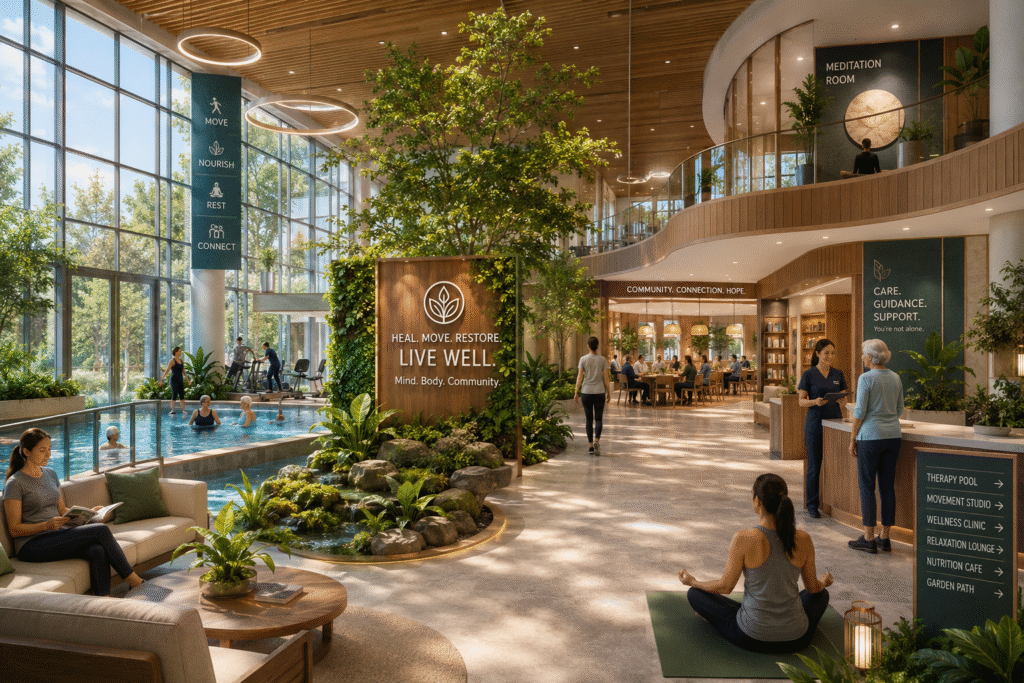
A center for wellness is more than a collection of therapies. It is a place designed around one idea: people should not have to choose between medical treatment and the support they need to recover, reconnect, and feel like themselves again.
When Treatment Ends, Recovery Is Not Over
Most people who enter a center for wellness are carrying something.
It may be a body still exhausted months after cancer treatment. It may be chronic pain, limited mobility, anxiety, poor sleep, or the uncertainty that follows a serious diagnosis. Sometimes it is simply the accumulated strain of modern life.
Medicine can be extraordinarily effective at diagnosing disease and treating its biological causes. But recovery is broader than disease control.
A person may be medically stable and still struggle to sleep. A tumor may be gone while fatigue remains. Surgery may be successful while strength, mobility, confidence, or body image take months to return.
This is where integrative care can play an important supporting role.
The National Cancer Institute describes integrative medicine as an approach that combines conventional medical treatment with complementary approaches that have evidence for safety and effectiveness. These approaches can include practices such as massage, acupuncture, meditation, and tai chi.
Leading cancer centers are already incorporating these services into conventional care. For example, MD Anderson’s Integrative Medicine Center offers physician consultation alongside acupuncture, exercise counseling, meditation, music therapy, nutrition consultation, health psychology, and oncology massage.
Integrative care is not about replacing medicine. It is about making the experience of recovery more complete.
What the World Can Teach Us About Recovery
The idea of creating dedicated environments for recovery is not entirely new.
Germany provides a particularly strong example of rehabilitation being treated as a formal part of the healthcare journey. Germany’s statutory system supports oncology rehabilitation after primary cancer treatment, with programs addressing physical, psychological, social, and occupational consequences of illness. Rehabilitation may be provided on an inpatient or outpatient basis, and eligible services can be financed through public institutions.
Japan offers another useful example. At Japan’s National Cancer Center Hospital East, rehabilitation is integrated into cancer care before and after surgery and during chemotherapy or radiation treatment. The center reported 3,949 cancer patients referred to its rehabilitation department in 2024.
The lesson is not that every city should copy another country’s healthcare system. The lesson is simpler:
Recovery can be organized.
It can be planned, professionally supervised, measured, and brought closer to the patient’s everyday life.
The Center Designed Around the Person
Imagine walking into a building where every space answers a different part of the recovery journey.
There is a therapy pool for someone who cannot comfortably exercise on land.
There is a rehabilitation gym for rebuilding strength.
There is a meditation room for a mind that will not slow down.
There is an acupuncture room for symptom management.
There is a quiet room for someone who simply needs silence.
There is a community table where survivors, caregivers, and neighbors can sit together.
The building itself becomes part of the care experience.
1. When Fatigue Will Not Go Away
Cancer treatment and chronic disease can leave people profoundly fatigued. The instinct may be to rest indefinitely, but appropriately prescribed physical activity can actually become part of recovery.
The National Cancer Institute notes that exercise can help people with cancer improve sleep, reduce fatigue, strengthen physical capacity, improve mental health, and increase mobility and strength.
That makes movement one of the most important spaces in a center for wellness.
The therapy pool
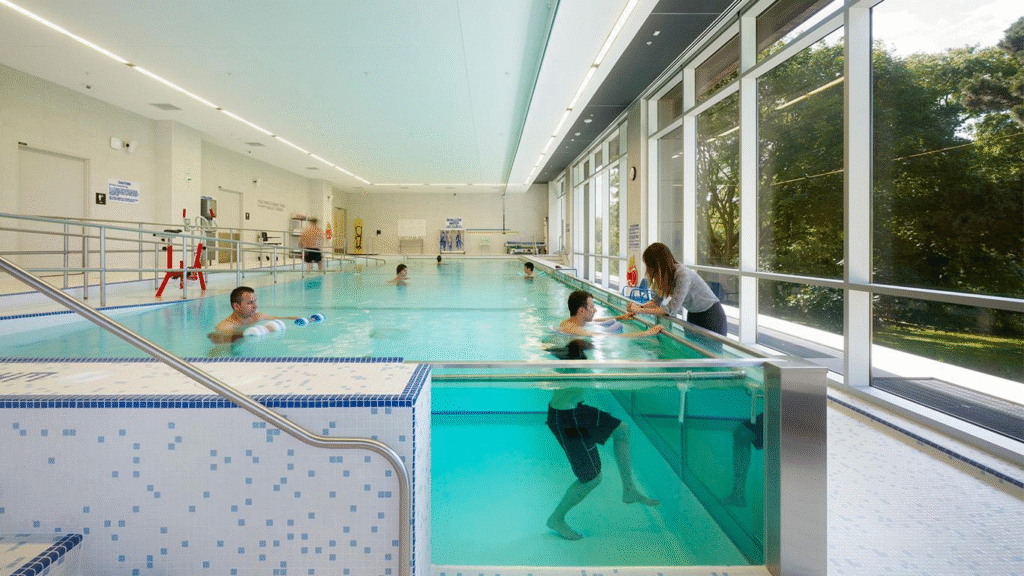
Water creates buoyancy, reducing the load placed on joints while allowing controlled movement. Aquatic therapy can be especially useful for people who are weak, deconditioned, or uncomfortable exercising on land.
A warm therapy pool can support:
- Gentle walking
- Range-of-motion exercises
- Balance training
- Stretching
- Low-impact strengthening
- Cardiovascular conditioning
The goal is not to push a recovering person into an intense workout.
The goal is to give them a safe place to begin moving again.
The movement studio
From the pool, rehabilitation can progress into supervised strength and mobility training.
Yoga, tai chi, and qigong can complement conventional exercise by combining movement with breathing, attention, and relaxation. Their usefulness depends on the individual’s condition and should be adapted accordingly.
The progression is simple:
Move → strengthen → regain confidence → return to life.
2. Pain, Swelling and a Body That Feels Different
Pain after surgery or treatment can affect far more than comfort. It can change how a person walks, sleeps, exercises, works, and interacts with other people.
A center for wellness can therefore bring several supportive services together.
Oncology massage
Massage performed by appropriately trained professionals may help with relaxation, stress, and selected symptoms. For people with cancer or recent surgery, however, treatment needs to be individualized around medical status, surgical sites, medications, and other risks.
Lymphatic rehabilitation
Some cancer treatments, particularly lymph-node surgery or radiation, can contribute to lymphedema. A center can provide assessment, education, compression support, and specialized therapy when clinically appropriate.
Acupuncture
Acupuncture is another area where evidence is developing.
Several systematic reviews have found potential benefits for chemotherapy-induced peripheral neuropathy, including improvements in pain and quality of life, although study quality and treatment protocols vary. A 2024 network meta-analysis involving 33 studies and 2,027 participants found benefits from acupuncture-related interventions for neuropathy symptoms, pain, and quality of life.
That makes acupuncture worth considering as a supportive therapy, not as a replacement for oncology treatment.
3. The Mind That Will Not Switch Off
Physical recovery is only half the story.
After a serious diagnosis, people may experience anxiety, low mood, fear of recurrence, disrupted sleep, or a persistent sense that something is wrong.
This is where the architecture of a wellness center matters.
The silence room
Imagine a room designed for almost complete acoustic quiet.
No televisions.
No phones.
No announcements.
No unnecessary conversation.
Just a place where a person can sit, breathe, and allow the nervous system to settle.
The meditation room
Guided meditation, breathing exercises, mindfulness, and imagery can give people practical tools for managing stress.
MD Anderson’s integrative oncology program includes meditation and other mind-body approaches as part of supportive cancer care.
The biofeedback room
Biofeedback could make relaxation more tangible by allowing people to observe physiological signals such as heart rate while practicing controlled breathing.
Instead of simply being told to “relax,” a person can learn:
This is what my body feels like when I become calmer.
That transforms relaxation from an abstract instruction into a skill.
4. Sound, Light and Immersive Relaxation
Technology can also create new environments for relaxation.
Immersive rooms may combine carefully designed lighting, sound, imagery, vibration, or guided meditation to create a controlled sensory experience.
But this is an area where responsible design matters.
Not every wellness technology has the same level of clinical evidence. Claims about specific sound frequencies, vibration programs, or “energy” effects should therefore be presented cautiously.
A credible center does not promise miracles.
It tells visitors:
Here is what the evidence supports. Here is what remains experimental. Here is what may simply help you feel more comfortable.
That distinction builds trust.
5. Heat, Cold and Recovery Spaces
Thermal environments can also become part of a wellness center.
Saunas, steam rooms, and carefully supervised thermal therapies may promote relaxation. Some research has explored potential cardiovascular effects of sauna bathing, but sauna and cold-water exposure are not appropriate for everyone, particularly people with certain medical conditions.
Cold-water immersion has become increasingly popular in commercial wellness settings, but many of its broader health claims remain under investigation.
That means a medically responsible center should never treat an ice plunge as a universal therapy.
Instead, it could offer:
- Medical screening
- Temperature-controlled exposure
- Staff supervision
- Clear contraindications
- Recovery periods
- Individualized protocols
The principle should always be:
Experience first. Evidence second? No. Evidence first, experience enhanced by design.
6. Designing for the Senses
Healing environments do not have to look clinical.
A center can use natural materials, daylight, plants, water, views of nature, comfortable acoustics, and warm textures to create an environment that feels less institutional.
The circadian light atrium
Natural daylight can help establish a stronger connection between the built environment and the body’s daily rhythms.
A wellness center could use an atrium or daylight-focused space for:
- Morning movement
- Reading
- Relaxation
- Group conversations
- Quiet work
- Outdoor connection
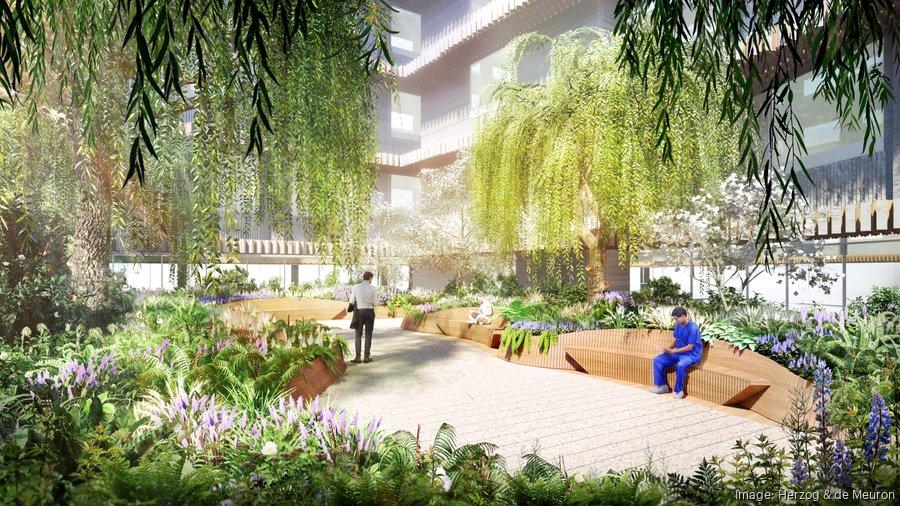
The biophilic space
Plants, natural materials, water, and views of greenery can make healthcare environments feel more welcoming.
The architecture does not need to announce:
You are a patient.
It can instead communicate:
You are a person, and you are welcome here.
7. Food as Support, Not a Miracle Cure
Nutrition deserves a place in the center, but it also deserves careful language.
A wellness center should never promise that a particular food, supplement, juice, herb, or diet can cure cancer.
Instead, registered dietitians and qualified nutrition professionals can help people address:
- Adequate protein and energy intake
- Weight changes
- Treatment-related eating difficulties
- Hydration
- Food safety
- Chronic disease nutrition
- Medication and supplement interactions
- Long-term healthy eating patterns
This is especially important because “natural” does not automatically mean safe.
Cancer centers have warned that some supplements and herbs can interact with medications or cancer treatment.
The nutrition philosophy should therefore be:
Food supports recovery. It does not replace medical treatment.
8. The Most Powerful Room May Be the Community Room
There is one form of suffering that no machine can directly treat: Isolation.
Serious illness can separate people from work, friends, routines, independence, and sometimes even their sense of identity.
That is why a center for wellness should not be built entirely around private treatment rooms.
At its heart should be a community commons.
Picture a shared table.
A survivor is having coffee.
A caregiver is attending a support group.
A nutritionist is teaching a cooking class.
A physiotherapist is leading a movement session.
A local resident has come for a public health talk.
People are not defined by their diagnosis.
They are simply people sharing the same space.
The U.S. Surgeon General’s advisory on social connection describes connection as important to individual and community health and cites evidence linking social isolation with increased risk of premature mortality. That means community should not be considered decorative programming.
Connection is part of the health environment.
What Could a Center for Wellness Actually Contain?
| Zone | Possible Services | Primary Purpose |
|---|---|---|
| Medical & Assessment | Integrative physician, nursing, screening, referrals | Safe coordination |
| Movement | Gym, physiotherapy, yoga, tai chi | Strength and mobility |
| Aquatic | Therapy pool, water exercise | Low-impact rehabilitation |
| Pain & Recovery | Massage, lymphatic therapy, acupuncture | Symptom support |
| Mind & Emotional Health | Meditation, psychology, biofeedback | Stress and emotional wellbeing |
| Thermal | Sauna, steam, supervised cold exposure | Relaxation and recovery |
| Nutrition | Dietitian, cooking education | Healthy eating and treatment support |
| Sensory | Quiet rooms, music, immersive relaxation | Rest and regulation |
| Nature | Gardens, plants, daylight, water | Connection with nature |
| Community | Support groups, survivor circles, classes | Belonging |
| Education | Health talks, workshops, digital resources | Health literacy |
The important word is coordination.
A collection of unrelated services is a spa.
A coordinated clinical and wellness ecosystem is something different.
The Numbers Behind the Opportunity
The concept also exists within a rapidly expanding global wellness economy.
According to the Global Wellness Institute, the global wellness economy reached approximately $6.8 trillion in 2024, growing 7.9% from 2023. The organization projects the market could approach $9.8 trillion by 2029.
Even more relevant to architecture and urban development is wellness real estate.
The Global Wellness Institute estimates that wellness real estate reached approximately $876 billion in 2025 and projects it could reach $1.8 trillion by 2030.
Key figures
$6.8T
Global wellness economy in 2024
$9.8T
Projected global wellness economy in 2029
$876B
Wellness real estate market in 2025
$1.8T
Projected wellness real estate market in 2030
19.5%
Average annual growth of wellness real estate from 2019–2024
12.4%
Average annual growth of mental wellness from 2019–2024
The opportunity is therefore larger than building another fitness center.
It is about creating health-supportive places.
From a Building to a Citywide Health Asset
Now imagine scaling the idea.
A center for wellness sits beside a hospital.
Another operates near a university.
Another is located inside a large residential district.
Another is placed in an underserved neighborhood.
People recovering from cancer can attend rehabilitation.
Older adults can work on balance and strength.
People with chronic conditions can receive lifestyle support.
Caregivers can find education and community.
Healthcare workers can use the spaces to recover from their own demanding schedules.
Healthy residents can participate in exercise, nutrition, mindfulness, and community programs.
The building becomes a bridge between healthcare and everyday life.
The Economic Argument
There is also a practical economic case.
When people recover better, they may be more capable of returning to work, maintaining independence, participating in family life, and managing chronic conditions.
Germany’s oncology rehabilitation system explicitly connects rehabilitation not only with physical and psychological recovery but also with participation in working life.
Japan’s National Cancer Center likewise describes rehabilitation as a way to preserve function and capability during cancer treatment and support patients’ return home.
This suggests a broader urban principle:
A healthier population is infrastructure.
Health is not simply something that happens inside hospitals.
It is shaped by the places where people move, rest, eat, connect, learn, and recover.
What Makes the Model Different?
The strongest version of a center for wellness would follow five principles.
1. Medical coordination
Services should be connected to qualified healthcare professionals rather than operating as isolated wellness treatments.
2. Evidence-aware practice
Treatments should be categorized according to the strength of available evidence.
3. Personalization
A person recovering from chemotherapy should not receive the same program as a healthy athlete.
4. Accessibility
Wellness cannot become another luxury service available only to wealthy residents.
5. Community
The building should create opportunities for people to meet, learn, and support one another.
The Center Should Know What It Does Not Know
This may be the most important principle of all.
A responsible center does not promise to cure cancer.
It does not claim that a sauna eliminates disease.
It does not present Reiki, sound frequencies, supplements, or cold plunges as proven treatments for every condition.
Instead, it distinguishes between:
Established medical care.
Evidence-supported supportive care.
Promising but developing approaches.
Wellness experiences intended primarily for comfort and relaxation.
That honesty is not a weakness.
It is what makes the center trustworthy.
Wellness for the Healthy, Too
The beautiful part is that the building does not have to belong exclusively to people who are sick.
The same therapy pool that helps someone regain mobility can help an older adult exercise safely.
The same meditation room used by a cancer survivor can help a stressed parent.
The same garden that gives a patient a place to breathe can give a healthcare worker somewhere to pause.
The same community table that hosts a survivor group can host a nutrition class.
This changes the meaning of wellness.
It stops being something people visit only when something has gone wrong.
It becomes part of ordinary life.
A New Definition of Healthcare Architecture
For generations, healthcare architecture has often focused on diagnosis, treatment, surgery, technology, efficiency, and infection control.
Those things remain essential.
But the next generation of health environments can ask additional questions:
Where does a person go after the treatment room?
Where do they rebuild strength?
Where do they learn to sleep again?
Where do they manage fear?
Where does a caregiver rest?
Where does a survivor meet someone who understands?
Where does a healthy person learn how to stay healthy?
The answer could be the center for wellness.
Conclusion: Build Places That Help People Become Themselves Again
The strongest case for a center for wellness is not that it contains more treatments.
It is that it creates a place where those treatments, people, relationships, and experiences can work together.
Medicine treats disease.
Rehabilitation restores function.
Psychology supports the mind.
Movement rebuilds confidence.
Nutrition supports the body.
Community reduces isolation.
Architecture brings all of them together.
The global wellness economy is already demonstrating enormous demand for environments designed around health and wellbeing. Meanwhile, healthcare systems in countries such as Germany and Japan show that rehabilitation can be organized as a meaningful part of recovery rather than an afterthought.
The opportunity now is to bring these ideas together in a new kind of civic building.
Not a hospital.
Not a spa.
Not a gym.
Something between them and, in important ways, something more human than all three.
A place where someone recovering from cancer can move again.
Where a person living with chronic illness can learn to manage life with greater confidence.
Where a caregiver can finally breathe.
Where a healthy person can protect the health they already have.
Where strangers become a community.
Every city has hospitals.
Every city has gyms.
Every city has parks.
Perhaps the next generation of cities needs something else: a home for healing.
And if we build those places well, we will not simply create healthier buildings.
We will create healthier people, stronger communities, and cities designed to help their residents thrive.
References:
National Cancer Institute (NCI) Complementary and Alternative Medicine
Supports the concept of integrating evidence-based approaches such as massage, acupuncture, meditation, tai chi, yoga, and biofeedback alongside conventional cancer care.
National Cancer Institute Complementary and Alternative Medicine
Deutsche Rentenversicherung Oncology Rehabilitation in Germany
Supports the idea of dedicated rehabilitation environments addressing the physical, psychological, social, and occupational consequences of cancer treatment.
Deutsche Rentenversicherung Oncology Rehabilitation



GIPHY App Key not set. Please check settings