
 Vivek Raman
Deep Cogito has just released Cogito v2, a powerful new family of open-source AI models designed to sharpen their own reasoning — not just their answers.
While AI models are often judged by size, Cogito v2 stands out for how it thinks. Yes, the numbers are impressive:
- 70B and 109B parameter models for mid-scale tasks
- 405B and 671B parameter models for large-scale reasoning
- The 671B Mixture-of-Experts (MoE) model is now among the most powerful open-source AIs in the world
But Cogito v2 is more than just big. It’s smart in a new way.
Smarter Reasoning, Not Just Bigger Models
Most AI models take longer at inference time — thinking more — to solve complex tasks. But Cogito v2 internalises its reasoning using a method called Iterated Distillation and Amplification (IDA).
Here’s how it works:
- The model explores different ways to solve problems.
- Then, it “distils” those discoveries directly into its core knowledge.
- Over time, it develops a kind of intuition — like a gut feeling for the right answer.
The result? Cogito v2 models solve problems with 60% shorter reasoning chains compared to rivals like DeepSeek R1. This makes them not only smarter, but faster and more efficient.
Surprisingly Affordable AI
Developing state-of-the-art AI usually costs tens or hundreds of millions of dollars. But Deep Cogito claims to have trained all of its Cogito v2 models for under $3.5 million total — a fraction of the cost of other labs.
This efficiency was made possible by:
- Focusing on hybrid reasoning
- Using IDA to learn faster and smarter
- Avoiding unnecessary complexity during training
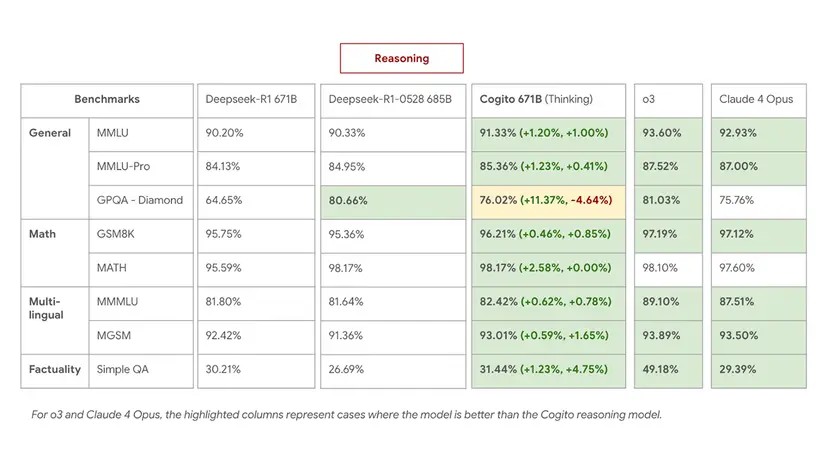
Real-World Results
The flagship Cogito v2 671B model performs remarkably well:
- Matches or beats the latest DeepSeek models on key benchmarks
- Competes closely with leading proprietary models like OpenAI o3 and Anthropic Claude 4 Opus
And there’s more: despite not being trained for image tasks, Cogito v2 shows surprising visual reasoning skills. In one example, it compared a duck and a lion across habitat, color, and composition — purely through transfer learning.
What’s Next?
Deep Cogito is doubling down on its approach. The team plans to keep improving its models through iterative self-learning — like climbing a hill, one step at a time, toward superintelligence.
Most importantly, they’re committed to keeping their work open-source. That means anyone in the world can learn from, use, and build on Cogito v2.
Final Thoughts
Deep Cogito’s release of Cogito v2 signals a major shift in AI development. Instead of relying on massive size or brute force, these models are being trained to reason better, learn faster, and think more like humans.
If you’re excited about the future of transparent, open, and intelligent AI — keep an eye on Deep Cogito.




GIPHY App Key not set. Please check settings