
 Vivek Raman
OpenAI has officially released GPT-5.2, its most advanced artificial intelligence model to date. Designed for professional-grade work, the new model focuses on handling complex reasoning, long-duration tasks, and workflows that require coordination with multiple tools and systems. While earlier models were already useful for everyday writing and assistance, GPT-5.2 aims to move AI deeper into serious knowledge work.
This release represents not just an incremental upgrade, but a strategic step toward making AI more dependable in real-world professional environments such as software development, data analysis, research, content creation, and enterprise operations.
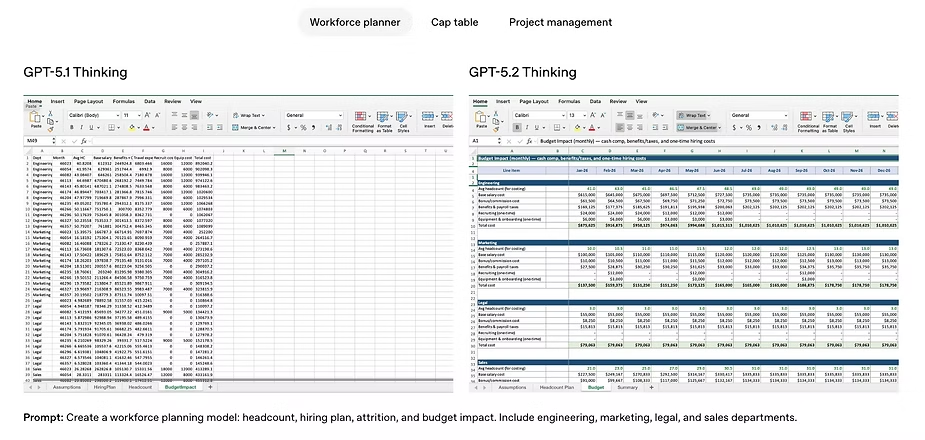
Built for Real Professional Work
One of the core goals behind GPT-5.2 is reliability at scale. Many professionals already use AI to speed up parts of their work, but earlier models often struggled with long documents, complex logic, or multi-step processes. GPT-5.2 is specifically engineered to handle these challenges more consistently. According to OpenAI, the model performs at an expert level in 70.9% of professional tasks across 44 occupations, as measured by the GDPval benchmark. This suggests that, in structured scenarios, GPT-5.2 can match or exceed human-level performance often completing tasks faster and at a lower operational cost.
Stronger Performance in Software Engineering
For developers, GPT-5.2 shows notable gains. It achieves 55.6% on SWE-Bench Pro, a demanding benchmark that evaluates real-world software engineering problems across four programming languages. On the earlier SWE-Bench Verified test, it reaches 80% accuracy, indicating a strong ability to understand existing codebases, fix bugs, and implement features. While this does not eliminate the need for human oversight, it does make GPT-5.2 a more practical coding partner especially for debugging, refactoring, and exploring implementation options.
Fewer Errors, Better Judgment
One of the most meaningful improvements is a reported 30% reduction in errors compared to GPT-5.1. This includes fewer hallucinations, better adherence to instructions, and more consistent reasoning. That said, OpenAI is clear that outputs should still be verified, particularly in high-stakes situations such as legal, financial, or medical work. This balance between increased accuracy and continued caution reflects a realistic understanding of how AI is currently used: as a powerful assistant, not a fully autonomous decision-maker.
Designed for Long Documents and Complex Context
GPT-5.2 supports context windows of up to 256,000 tokens, allowing it to analyze and reason across extremely large documents. This makes it practical for reviewing long contracts, research papers, policy documents, or even entire multi-file project repositories without losing context. For professionals who regularly deal with dense or fragmented information, this capability alone can significantly reduce manual effort and cognitive load.
Reliable Tool Use and Multi-Step Workflows
Another major advancement is GPT-5.2’s ability to coordinate actions across tools. It scores 98.7% on tool-calling benchmarks, meaning it can reliably handle workflows that involve multiple steps such as querying databases, interacting with APIs, updating documents, or managing customer service processes. This improvement is critical for enterprise use cases, where AI needs to act less like a chatbot and more like an intelligent system operator.
Advanced Knowledge in Science and Mathematics
GPT-5.2 also demonstrates strong performance in advanced academic domains. It scores 93.2% on GPQA Diamond, a graduate-level science benchmark, and successfully solves 40.3% of expert-level mathematics problems. While it is not replacing human researchers, these results show meaningful progress in high-level reasoning and technical understanding.
Flexible Configurations for Different Needs
To accommodate different workloads, OpenAI offers GPT-5.2 in three configurations:
- Instant: Optimized for speed and everyday tasks
- Thinking: Designed for deeper reasoning and complex problem-solving
- Pro: Focused on maximum accuracy, even if responses take longer
This tiered approach allows users and organizations to balance speed, cost, and reliability based on their specific needs.
Benchmarks vs. Real-World Work
Despite impressive metrics, benchmarks only tell part of the story. Real professional work is often ambiguous, context-heavy, and constantly changing. Tasks may evolve mid-way, requirements may be unclear, and success often depends on human judgment rather than strict correctness.
OpenAI itself acknowledges this gap by encouraging users to review critical outputs. GPT-5.2 narrows the distance between test performance and real-world usefulness, but it does not eliminate the need for human supervision.
Is the Upgrade Worth It?
GPT-5.2 comes with higher API pricing, signaling OpenAI’s confidence in its improved capabilities. For teams that rely heavily on AI for complex workflows, the quality gains may justify the cost. For casual users, earlier models may still be sufficient. Ultimately, GPT-5.2’s success will not be defined by its benchmark scores alone. Its true value lies in how effectively it supports professionals in the messy, unpredictable reality of daily work where context, judgment, and adaptability matter as much as raw intelligence.
more information : GPT-5.2



GIPHY App Key not set. Please check settings