
 Vivek Raman
Based on the U.S. Department of Labor’s AI Literacy Framework (Training and Employment Notice No. 07-25, released February 13, 2026)
Introduction
Artificial Intelligence (AI) is no longer a technology confined to science fiction or research labs, it has quietly become part of our everyday lives. Every time we ask a virtual assistant a question, get a movie recommendation on Netflix, use Google Maps for directions, or chat with tools like ChatGPT or Claude, we are interacting with AI.
As AI becomes woven into education, healthcare, business, finance, agriculture, manufacturing, and entertainment, one skill is quickly becoming as essential as reading, writing, and basic computer literacy: AI literacy.
AI literacy isn’t about becoming a computer programmer or a machine learning engineer. It’s about understanding what AI is, what it can and cannot do, how to use it effectively, how to evaluate its answers, and how to use it ethically and responsibly.
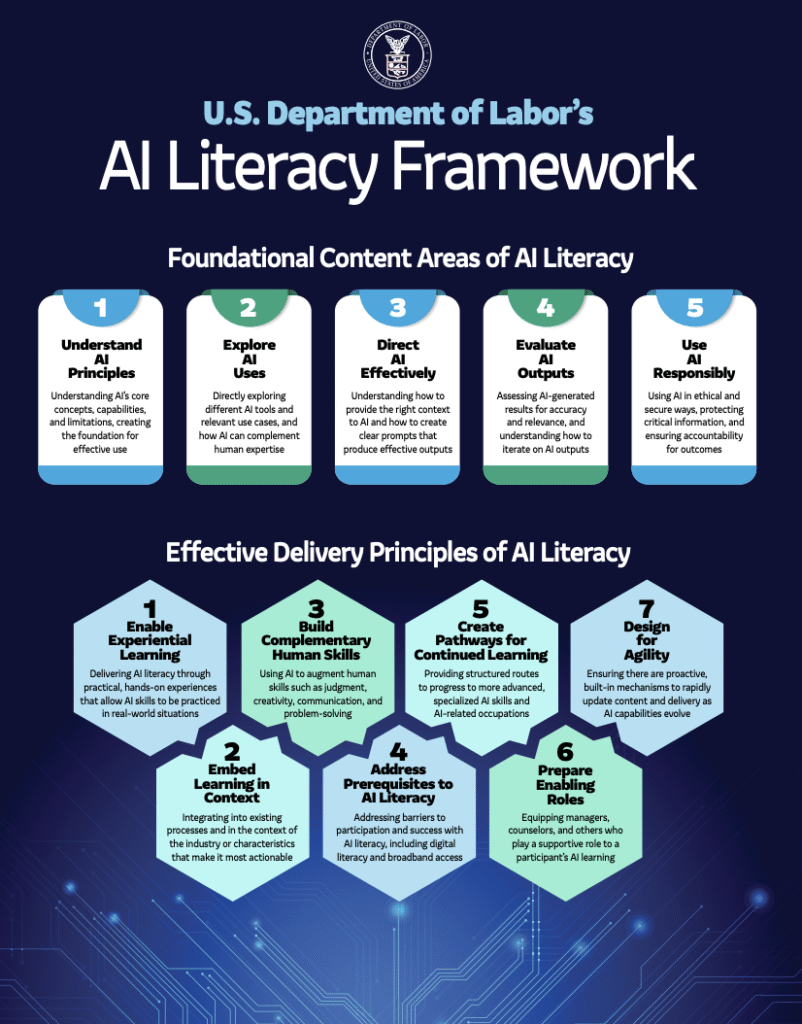
To help standardize this growing need, the U.S. Department of Labor’s Employment and Training Administration (ETA) published a national AI Literacy Framework on February 13, 2026, through Training and Employment Notice (TEN) No. 07-25. It gives students, professionals, educators, organizations, and lifelong learners a shared roadmap for building these essential skills, and it is built around two components:
- Five Foundational Content Areas (the “what” of AI literacy)
- Seven Effective Delivery Principles (the “how” of teaching it)
Together, these prepare people to confidently and responsibly use AI throughout their education, careers, and daily lives. The framework is voluntary guidance, not a binding regulation, it’s meant to be adapted, not mandated, across industries, roles, and educational settings.
source: U.S. Department of Labor: AI Literacy Framework announcement
What is AI Literacy?
AI Literacy is the ability to:
- Understand what Artificial Intelligence is.
- Know how AI systems work at a basic level.
- Use AI tools effectively.
- Evaluate AI-generated information critically.
- Recognize AI’s limitations.
- Use AI ethically and responsibly.
Think of AI literacy like learning to drive a car.
Driving isn’t just about pressing the accelerator. A good driver understands how the car works, knows traffic rules, practices road safety, knows when to brake, and knows what to do in emergencies.
Similarly, using AI isn’t just about typing a question into a chatbot. A person who is AI literate knows:
- How AI produces its answers
- When AI is likely to make mistakes
- How to ask better, more precise questions
- How to verify the information it gives
- How to protect their own and others’ personal information
According to the Department of Labor’s own definition, AI literacy is a foundational set of competencies that enable individuals to use and evaluate AI technologies responsibly, with a primary focus on generative AI, which is increasingly central to the modern workplace.
Why is AI Literacy Important?
Artificial Intelligence is changing almost every profession:
- Doctors use AI to assist with medical diagnosis and analyze scans.
- Teachers use AI to create personalized learning experiences.
- Engineers use AI to design better products faster.
- Farmers use AI to monitor crop health and predict yields.
- Scientists use AI to analyze massive, complex datasets.
- Businesses use AI to improve customer service and detect fraud.
- Artists and musicians use AI to enhance and accelerate creativity.
The Department of Labor puts it plainly: every worker will need baseline AI literacy skills to succeed, regardless of industry or occupation, and organizations are being urged to help onboard new hires, upskill current employees, and ensure managers can guide AI adoption.
Without AI literacy, people may:
- Trust incorrect AI answers without questioning them
- Share sensitive personal information carelessly
- Become overly dependent on AI
- Misuse AI tools (intentionally or not)
- Miss out on emerging career opportunities
With AI literacy, people can:
- Learn faster and work smarter
- Solve problems more efficiently
- Think more critically about the information they receive
- Make better-informed decisions
🎥 Watch: Navigating the DOL AI Literacy Framework for an AI-Ready Workforce (YouTube)
The Five Foundational Content Areas of AI Literacy
These five pillars represent the essential knowledge every AI user should have.
1. Understand AI Principles
Before using AI, we need to understand what it actually is. Artificial Intelligence is a computer system designed to perform tasks that usually require human intelligence: understanding language, recognizing faces, translating text, making predictions, recommending products, and answering questions.
But AI is not human. It doesn’t think, feel, or understand the world the way people do. Instead, it learns statistical patterns from enormous amounts of data and uses those patterns to generate responses or predictions.
What AI can do:
- Write essays and summaries
- Translate languages
- Generate computer code
- Create images
- Analyze data and detect patterns
- Answer questions and generate ideas
What AI cannot always do well:
- Guarantee factual accuracy
- Fully understand context the way a human does
- Stay free of bias
- Know about very recent events (depending on the tool)
- Avoid “hallucinating” : confidently stating false information
Example: If you ask an AI tool “Who invented the light bulb?”, it might answer simply “Thomas Edison.” While Edison improved the commercially viable light bulb, inventors like Joseph Swan and Humphry Davy also made important early contributions. Without understanding this limitation, someone might walk away with an incomplete picture.
Key Lesson: AI is a helpful assistant, not an all-knowing expert.
The framework describes this content area as helping workers grasp how AI systems rely on pattern recognition and probabilistic outputs, how training differs from inference, and why hallucinations occur.
2. Explore AI Uses
Once we understand what AI is, the next step is learning where and how it can actually be useful.
AI in Education Students use AI to explain difficult concepts, practice math, learn programming, improve writing, summarize notes, and prepare for exams. Example: Instead of copying homework answers, a student should ask, “Can you explain Newton’s Laws with simple, real-world examples?” This encourages learning rather than dependency.
AI in Healthcare Doctors use AI to analyse X-rays, detect diseases earlier, predict patient risk, and manage medical records , AI assists doctors, it does not replace them.
AI in Business Companies use AI for customer support chatbots, inventory management, marketing campaigns, sales forecasting, and fraud detection.
AI in Agriculture Farmers use AI to predict rainfall, monitor crop health, detect plant disease, and optimize irrigation, an increasingly important application as smart farming grows.
AI in Daily Life Most people use AI every day without even realizing it : through Google Search, Siri, Alexa, Google Maps, Netflix recommendations, Spotify playlists, and email spam filters.
Key Lesson: AI works best when it complements human expertise rather than replacing it.
3. Direct AI Effectively (Prompting)
Using AI effectively depends heavily on giving it clear instructions. This skill is called prompting.
What is a prompt? It’s the instruction or question you give an AI system.
| Poor Prompt | Better Prompt |
| “Tell me about space.” | “Explain the solar system to a 10-year-old using simple language and examples.” |
| “Write an essay.” | “Write a 500-word essay about climate change suitable for Grade 8 students, with examples.” |
| “Create a presentation.” | “Create a 10-slide presentation explaining renewable energy for high school students.” |
A good prompt typically includes:
- Context: background information
- Audience: who the output is for
- Style: tone, formality, format
- Level of detail: how deep or simple the answer should be
Key Lesson: Better prompts produce better results. AI cannot read your mind, the more information you give it, the better the output.
For deeper guidance on this skill, Anthropic publishes a detailed prompt-engineering guide:
4. Evaluate AI Outputs
Even when AI gives an answer, it should never be accepted blindly.
Check for:
- Accuracy: Does this match trusted sources?
- Relevance: Does this actually solve my problem? Is it right for my audience?
- Completeness: What information might be missing?
Verify using:
- Books and academic journals
- Government websites
- Teachers or subject-matter experts
Example: If AI says “Bananas grow on trees,” a botanist or science teacher would point out that bananas actually grow on large herbaceous (non-woody) plants, not true trees. This is exactly why verification matters.
Improve through iteration: if an AI’s first answer isn’t ideal, ask follow-up questions:
- “Explain that in simpler words.”
- “Add real-world examples.”
- “Give me sources or references.”
- “Compare this with another concept.”
Key Lesson: Critical thinking is more important than blind acceptance of AI answers.
5. Use AI Responsibly
Responsible AI use means using it ethically, safely, and legally.
Protect Privacy: Never share passwords, bank details, medical records, government ID numbers, or confidential company information with an AI tool.
Respect Copyright: Don’t use AI to copy someone else’s work and pass it off as your own; acknowledge sources where required.
Avoid Harmful Use: AI should never be used to spread misinformation, create scams, cheat on exams, harass others, or generate harmful content.
Be Accountable: Humans remain responsible for decisions made with AI’s help. If AI helps write a report, the author is still accountable for verifying its accuracy.
The framework frames this directly: workers must understand the boundaries of appropriate use, both to safeguard information and to ensure outputs are applied ethically and effectively… recognizing the limits of AI authority, protecting sensitive data, complying with workplace or legal requirements, and maintaining accountability for outcomes.
Key Lesson: Responsible AI users think about the consequences of their actions.
The Seven Effective Delivery Principles of AI Literacy
Knowing what to teach is only half the journey, the framework also explains how AI literacy should be delivered.
1. Enable Experiential Learning
People learn best by doing. Rather than only reading about AI, learners should experiment with real tools, solve real-world problems, practice writing prompts, and compare different AI responses. As the framework notes, this hands-on approach accelerates skill development by helping users see results firsthand rather than learning about AI only in the abstract.
2. Embed Learning in Context
AI education works best inside real-life situations : AI in healthcare for medical students, AI in law for legal professionals, AI in agriculture for farmers, AI in business for managers. Learning becomes meaningful when tied to everyday work.
3. Build Complementary Human Skills
AI cannot replace uniquely human abilities: creativity, judgment, empathy, leadership, ethical decision-making, communication, and collaboration. The framework’s own language emphasizes that AI amplifies human capabilities, it doesn’t replace them, so training should highlight how AI enhances critical thinking and creativity rather than substituting for it.
4. Address Prerequisites to AI Literacy
Not everyone has equal access to technology. Effective programs must account for digital literacy gaps, internet access, affordable devices, and accessibility for people with disabilities, AI literacy should be available to everyone, not just the digitally privileged.
5. Create Pathways for Continued Learning
AI evolves rapidly, so learning can’t stop after one course. The framework treats foundational literacy as a “starting point,” encouraging learners to progress through online courses, workshops, certifications, and hands-on projects.
6. Prepare Enabling Roles
Managers, teachers, counsellors, and mentors play a critical role in supporting AI learning. Organizations should equip these people through approaches like train-the-trainer models to guide learners, encourage ethical AI use, and foster a culture of responsible adoption.
7. Design for Agility
AI technology changes fast, so training programs must evolve with it. The framework notes that because “AI technologies evolve at a pace unlike previous workplace tools,” programs need modular content design, continuous updates, and feedback-driven iteration.
Bringing It All Together
The Department of Labor’s AI Literacy Framework emphasizes that AI literacy is more than learning how to operate AI tools: it’s about developing the knowledge, skills, and judgment needed to work with AI confidently and responsibly.
- The five foundational content areas help people understand AI, use it effectively, evaluate its outputs, and act ethically.
- The seven delivery principles ensure AI education is practical, inclusive, adaptable, and connected to real-world needs.
Whether you’re a child using AI to learn, a student completing assignments, a teacher designing lessons, or a professional improving workplace productivity- AI literacy empowers you to treat AI as a thoughtful partner, not something to rely on blindly.
It’s worth noting that the framework has also drawn some constructive criticism. Some commentators argue it focuses mainly on how to use AI tools well, but spends less time on deeper questions, such as understanding bias as a structural feature of AI systems, or asking whose data shaped a given model’s worldview. This is a fair point worth keeping in mind: full AI literacy benefits from pairing practical, “how-to” skills with a critical eye toward how these systems are built and whose interests they may (or may not) reflect.
Conclusion
Artificial Intelligence is reshaping how we learn, work, communicate, and solve problems. Just as reading and computer literacy became essential skills for previous generations, AI literacy is becoming a core competency for the future.
The U.S. Department of Labor’s AI Literacy Framework offers a practical, voluntary roadmap for developing these competencies. By understanding AI principles, exploring meaningful applications, learning to prompt effectively, evaluating outputs critically, and using AI responsibly, individuals can capture AI’s benefits while minimizing its risks.
Ultimately, AI is a powerful tool, but its true value depends on informed, ethical, and skilled human users. Building AI literacy today equips learners of all ages to participate confidently in an AI-driven world, and to help shape a future where technology serves humanity responsibly and effectively.
Reference Links
- U.S. Department of Labor: Official Announcement
- Training and Employment Notice No. 07-25 (Official Notice)
- Complete AI Literacy Framework Document (PDF)
- WorkforceGPS Resource Page on the Framework
- American Psychological Association: Overview of the Framework
- Stanford Teaching Commons: Understanding AI Literacy (academic framework)
Related YouTube Videos
- Navigating the DOL AI Literacy Framework for an AI-Ready Workforce
- AI 101: What is AI Literacy?
- AI Literacy: What Everyone Needs to Know!
- AI Literacy Crash Course
- What is AI? Complete Beginner’s Guide to Artificial Intelligence & History
- A Practical Guide to AI Literacy | Shop Talk




GIPHY App Key not set. Please check settings