
 Vivek Raman
How the data-center industry and the AI boom powering it can stop burning the planet’s water and start warming your home instead.
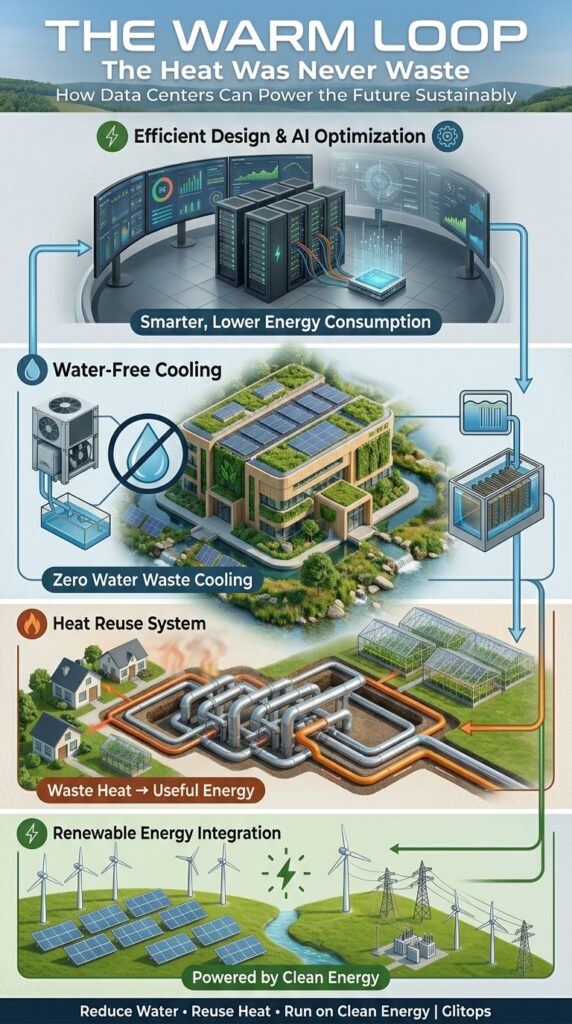
In a suburb of Helsinki, a resident turns on a kitchen radiator and doesn’t notice anything unusual. The warmth came, in part, from a GPU training an AI model a few kilometers away. That loop from server to radiator already exists at scale. Almost none of its logic has reached the United States.
Part 1 The Scale: A Grid-Scale Problem Hidden in Plain Sight
The data-center industry is no longer a niche corner of the energy system. It is now a primary driver of electricity demand growth and its resource footprint is propagating directly into household bills.
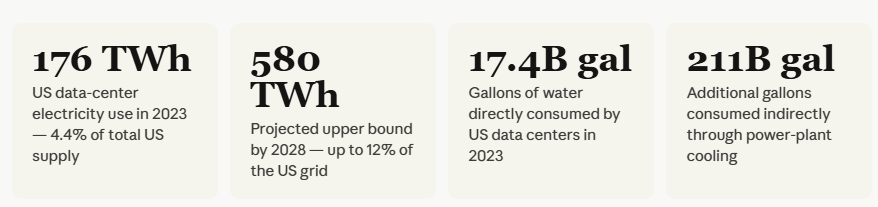
That indirect figure 211 billion gallons, nearly 13 times the direct number is the single most overlooked statistic in the entire debate. Every time a data center draws power from a coal or gas plant, that plant evaporates river and lake water to cool itself. The data center’s water footprint doesn’t end at the fence line.
The economic signal is already reaching households. In the PJM electricity market, which covers 65 million Americans from Illinois to North Carolina, data-center demand contributed to a $9.3 billion capacity-market price increase for 2025–26. Residential rates in parts of the region rose up to 20 percent in the summer of 2025.
“An industry at 4.4 percent of the US grid and climbing toward 12 percent will be regulated. The only question is whether the rules arrive by design or by crisis.”
Part 2 The Reframe: Heat Is a Product. Water Is Optional.
Every joule of electricity that enters a data center eventually leaves as heat. That is not a design flaw it is thermodynamics. For most of computing history, engineers treated that heat as waste to be disposed of, and the cheapest disposal method was evaporating water in a cooling tower.
Both choices were rational when computing was a tiny fraction of the grid and water was abundant where facilities were sited. Neither is rational now.
The core reframe Once heat is treated as a product rather than waste, every design decision flips. You stop trying to dilute it into the atmosphere and start concentrating it, keeping it at a useful temperature, and moving it intact to somewhere that needs it. Raising server outlet temperature from 35°C to 60°C is an inconvenience if you’re throwing the heat away and a triumph if you’re selling it to a district heating network.
Once water is treated as optional not a free solvent the entire evaporative-cooling paradigm becomes a legacy choice. Sealed-loop coolants piped directly onto chips can be filled once at construction and circulate indefinitely. Two-phase dielectric fluids boil at the chip surface and condense on a coil in the tank lid. No fans, no water at all.
Part 3 Proof Points : The Warm Loop Is Already Running
These are not pilot projects or concept renders. They are in operation today.
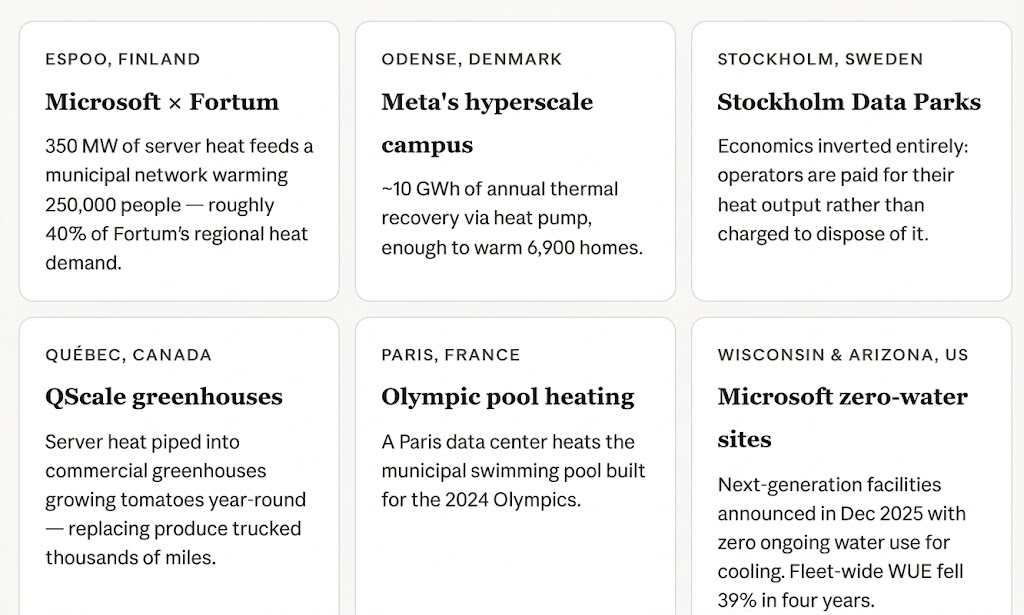
What these examples share is not a technology it’s an assumption: that a data center is a node in a local energy economy rather than an isolated consumer. The list of viable heat recipients is now long enough that almost any siting decision can be paired with a destination, if the decision is made early.
Part 4 Why Markets Won’t Fix This Alone : The Market’s Honest Limit
Every technology described above is real, commercially available, and demonstrably effective. Every one is also more expensive upfront than what it replaces. Closed-loop cooling costs more than an evaporative tower. Waste-heat recovery requires pipes and a contractual buyer. Left to market forces alone, the cheapest option wins and in 2026, the cheapest option is still evaporation plus grid electricity.
This is not a new problem. It is precisely the problem the power sector faced with coal plants in the 1960s. Smokestack scrubbers existed. Electrostatic precipitators existed. Low-sulfur fuel switching existed. None was widely adopted until the Clean Air Act of 1970 made them mandatory. The technology was ready; the incentive was not. Once the rules changed, adoption was rapid and compliance itself became an economic opportunity.
The data-center industry is at the same inflection point. The tools are ready. The policy is not.
Part 5 The Policy Landscape What Europe Mandates and America Doesn’t
Europe has quietly built the world’s first regulatory framework for digital infrastructure sustainability. Four elements define what is emerging and what the United States entirely lacks at the federal level.
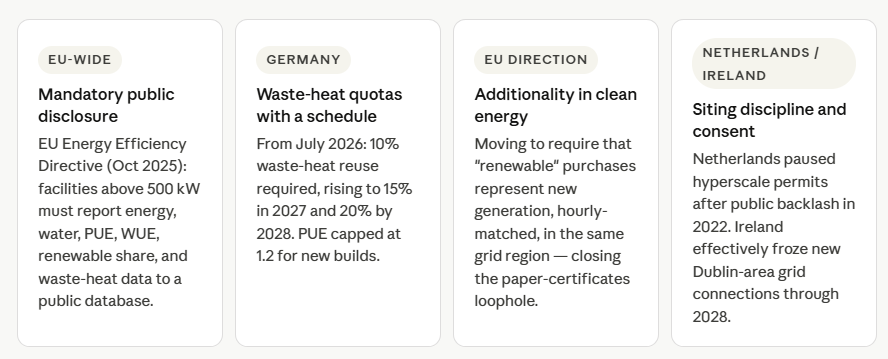
The United States has none of this at the federal level no mandatory reporting, no waste-heat requirement, no additionality rule. In Virginia, a recent review found that 80 percent of municipalities hosting data centers had non-disclosure agreements with developers shielding basic resource information from residents. That is the opposite of the European direction, and it is politically unsustainable.
Part 6 The Three Asks : Who Needs to Do What
The warm loop closes in three places, each requiring a different actor.
For operators & AI business leaders
- Require facility-level WUE and PUE disclosure quarterly from your data-center providers.
- Prefer chip-level liquid cooling and closed-loop designs for new AI workloads, especially in water-stressed regions.
- Move procurement toward hourly-matched, additionality-certified clean energy and treat it as a water strategy, not just a carbon one.
- Engage with the EU regulatory process now. It will shape your North American operating environment within a decade.
For policymakers
- Mandate facility-level water and energy reporting modeled on the EU Directive.
- Phase in waste-heat utilization requirements modeled on Germany’s Energy Efficiency Act.
- Write siting tests tied to watershed and grid-capacity thresholds with automatic moratorium triggers before the next crisis forces reactive rationing.
- Set sunset dates for open-loop evaporative cooling on the same model used for incandescent bulbs and combustion engines.
For host communities
- Demand public disclosure before permits are issued end NDA-based siting that turns residents into silent partners.
- Negotiate community benefit agreements tied to resource use: subsidized heat, broadband, job training.
- Invest in district-heating infrastructure. The Nordic model wasn’t accidental it was built by cities that decided, decades ago, that centralized heat was public infrastructure worth owning.
“The heat was never waste. The water was never free. We just hadn’t built the pipe yet and we hadn’t written the rules that require the pipe to be there.”
The data-center sector sits at roughly 4.4 percent of US electricity and is on track to double or triple by 2028. An industry of that scale will be regulated. The European answer is now visible. The American answer is not yet written but the engineering, the examples, and the economic logic are all in place. What remains is the decision to act before the backlash forces the issue.




GIPHY App Key not set. Please check settings