
 Vivek Raman
Canva wrapped up its 2025 World Tour finale in Sydney last week with a keynote that went far beyond a standard product announcement. Founders Melanie Perkins, Cliff Obrecht, and Cameron Adams took the stage to unveil nine major product launches, but the event’s deeper focus was on a broader question: where are creative professionals actually headed, and what tools do they need to get there?
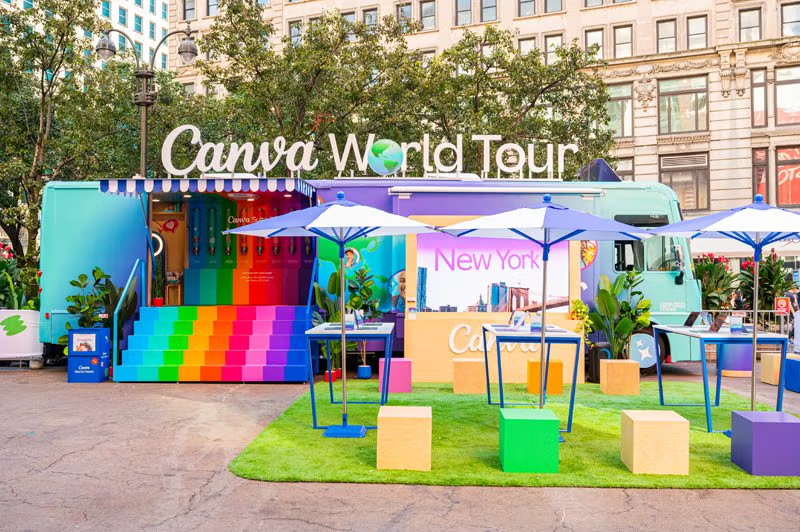
After traveling to more than 40 cities across 30 countries, Canva’s team gathered over one million feature requests directly from its global community. The updates announced in Sydney are positioned as a direct response to that feedback. With over 40 billion designs created on the platform roughly 433 new designs every second Canva is clearly evolving from a simple graphic design tool into a comprehensive creative and marketing platform.
Alongside product innovation, the company reaffirmed its long-standing commitment to social impact, highlighting $100 million in partnerships addressing poverty and more than $1.5 billion in product value donated to educators and nonprofits worldwide.
From Design Tool to Creative Ecosystem
What stood out most during the keynote was how far Canva’s ambitions now extend. The platform is no longer just about creating social posts or presentations. It is moving decisively into video editing, data collection, professional-grade creative tools, and marketing automation areas traditionally handled by multiple specialized products.
Rather than asking creators to stitch together disconnected tools, Canva is attempting to bring these workflows into a single, integrated environment.
Key Announcements From the Keynote
Video 2.0: Advanced Editing Without the Learning Curve
Video 2.0 introduces a redesigned editor that offers more powerful video capabilities while keeping Canva’s signature ease of use intact. The goal is to make video creation approachable for non-experts without limiting more experienced creators. As video continues to dominate digital communication, this update positions Canva as a serious player beyond static design.
Interactive Forms and Canva Code: Where Creativity Meets Data
With Interactive Forms and Canva Code, Canva is blurring the line between design and data. Users can now collect information directly within their designs and connect it to workflows without relying on external tools. This opens the door to use cases like feedback collection, registrations, and lightweight apps all built inside Canva.
Email Design: Branded, Responsive Emails in One Place
The new Email Design feature allows users to create responsive, on-brand emails without leaving Canva. For marketing teams and small businesses, this removes another friction point by eliminating the need to switch between design software and email platforms during the creation process.
Canva Design Model: AI That Understands Design Principles
The Canva Design Model introduces an AI system trained to understand fundamental design concepts. Instead of generating static outputs, it produces fully editable layouts from short prompts, allowing creators to refine and customize results. This moves Canva’s AI beyond automation toward genuine creative collaboration.
Ask Canva: A Built-In Design Assistant
Ask Canva acts as a real-time design assistant, offering layout, spacing, and style suggestions while users work. Rather than replacing creativity, it aims to support better decisions at the moment they matter especially useful for users without formal design training.
Canva Grow: Marketing Workflows Under One Roof
With Canva Grow, the company enters the marketing operations space. This workspace helps businesses plan, publish, and manage campaigns end to end. It’s a clear signal that Canva wants to be involved not just in creating assets, but in managing how those assets perform in the real world.
Canva Brand System: Consistency at Scale
The updated Canva Brand System focuses on one of the most persistent challenges for teams: brand consistency. By embedding brand guidelines directly into the tools people use daily, Canva aims to reduce errors and friction across large, distributed teams.
Affinity Relaunch: Professional Tools, Now Free
Perhaps the most surprising announcement was the relaunch of Affinity, Canva’s professional creative suite for vector, pixel, and layout design now offered completely free.
Professional design software has traditionally come with high recurring costs, creating barriers for students, freelancers, and small studios. Removing that price tag fundamentally changes the equation. Whether Affinity can compete with long-established industry standards in demanding real-world projects remains to be seen, but eliminating cost as a barrier is a significant move that will be hard to ignore.
Social Responsibility: Design With a Broader Purpose
Canva closed the keynote by reinforcing its commitment to education, sustainability, and poverty alleviation. These initiatives are not presented as side projects, but as core to the company’s mission—integrated into how the platform is built and shared globally.
Why the Affinity Decision Matters
Of all the announcements, the decision to make Affinity free stands out. Cost has long shaped who gets access to professional creative tools. By removing that barrier, Canva potentially expands the creative economy especially for learners and independent creators who previously had to compromise.
Performance, adoption, and industry acceptance will determine whether Affinity becomes a true alternative to entrenched tools, but the shift alone changes expectations across the creative software landscape.
The Bigger Question: Does Integration Actually Save Time?
What may be more important than any single feature is how well all these pieces work together. A platform that handles everything from data collection to campaign publishing sounds efficient, but the real test is whether it simplifies workflows or simply relocates complexity.
For small teams managing multiple subscriptions and logins, consolidation could be genuinely liberating. For larger organizations, embedding brand systems directly into daily work could resolve long-standing inefficiencies. At the same time, relying so heavily on one ecosystem means placing trust in that company’s long-term direction.




GIPHY App Key not set. Please check settings