
 Vivek Raman
Google has officially unveiled Gemini 3, its most advanced artificial intelligence model to date, marking a major milestone in the company’s AI roadmap. The announcement was made on The Keyword by Sundar Pichai, CEO of Google and Alphabet, alongside Demis Hassabis, CEO of Google DeepMind, and Koray Kavukcuoglu, CTO of Google DeepMind. This release represents the culmination of nearly two years of research and development since the original Gemini model was introduced, reflecting Google’s sustained investment in next-generation AI systems.
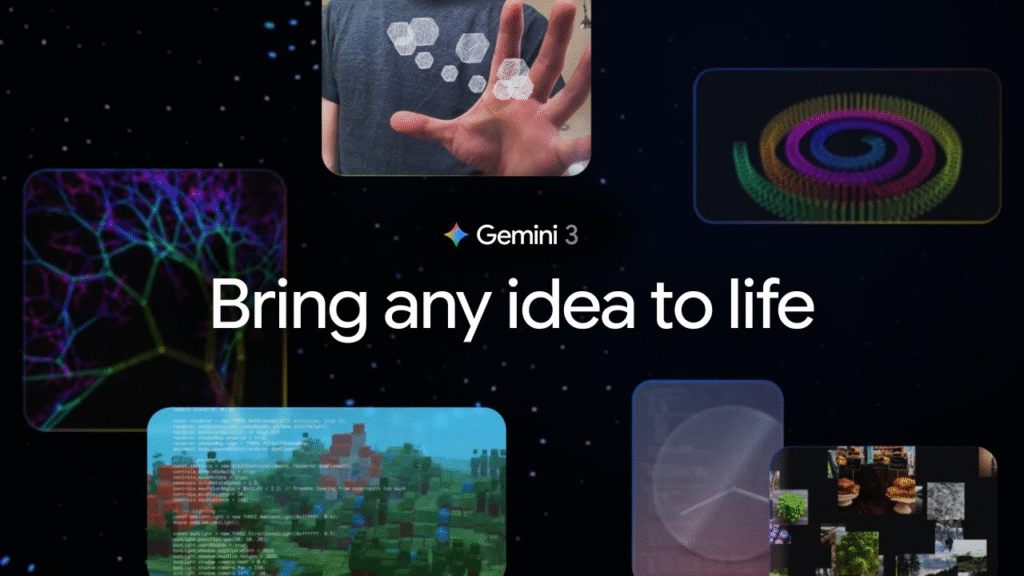
Google reports that adoption of its AI ecosystem has accelerated rapidly over the past year. The Gemini app now reaches more than 650 million monthly active users, while AI Overviews integrated directly into Google Search serve approximately 2 billion people each month. With Gemini 3, Google aims to move beyond incremental upgrades and deliver a system that meaningfully advances reasoning, understanding, and autonomy in AI. The model is designed to combine stronger logical reasoning, richer multimodal comprehension across text, images, audio, and video, and more agent-like behavior that enables it to take initiative rather than simply respond to prompts.
What sets Gemini 3 apart
Google positions Gemini 3 as a step change rather than a routine iteration. One of its defining goals is the ability to handle multi-step reasoning, allowing the model to work through complex problems that require planning, inference, and decision-making across multiple stages. This is particularly important for real-world tasks, where solutions rarely involve a single, straightforward answer.
Another major focus area is long-context understanding. Gemini 3 is tested on significantly longer inputs to evaluate whether it can maintain coherence, recall earlier details, and adapt responses over extended interactions. This capability is essential for use cases such as research analysis, long-form writing, and ongoing project support.
Google has also placed emphasis on how the model performs when information is incomplete, ambiguous, or uncertain. Rather than relying on perfectly framed prompts, Gemini 3 is evaluated on its ability to reason through gaps in information, ask clarifying questions when needed, and avoid overconfident or misleading responses. In addition, some assessments specifically measure the model’s ability to explain its reasoning, offering transparency into how conclusions are reached instead of simply presenting final outputs.
Behind the scenes, Google notes increased collaboration across research and engineering teams to develop more consistent and rigorous evaluation standards. This reflects a broader industry challenge: as AI systems grow more capable, traditional benchmarks struggle to capture real-world performance accurately.
From benchmarks to real-world use
While Gemini 3’s benchmark results are impressive, Google acknowledges that such metrics are generated under controlled conditions. Real-world usage is far messier. User requests are often vague, tasks span multiple domains, and many problems do not fit neatly into predefined test categories. Performance in everyday scenarios where context shifts, goals evolve, and constraints are unclear will ultimately matter more than leaderboard rankings.
To demonstrate practical potential, Google shared examples that highlight Gemini 3’s versatility. These include translating handwritten family recipes into usable digital formats, analyzing sports videos to provide personalized technique feedback, and transforming dense academic research papers into interactive study guides. Such examples showcase how multimodal understanding can unlock value in both personal and professional contexts.
Google also introduced Google Antigravity, a new initiative focused on autonomous AI agents. Under this framework, Gemini-powered agents can plan projects, write and debug code, and independently check their own work. This points toward a future where AI systems are not just assistants, but collaborators capable of managing entire workflows with minimal human oversight.
Safety, trust, and realistic expectations
Ahead of release, Gemini 3 underwent extensive safety evaluations conducted by Google’s internal teams as well as external organizations, including the UK’s AI Safety Institute (AISI) and Apollo. These reviews aim to identify risks related to misuse, reliability, and unintended behavior. While such testing is a critical step, Google acknowledges that early demonstrations often reflect ideal conditions rather than average, everyday performance.
What comes next
Ultimately, Gemini 3’s real impact will be determined not by announcements or demos, but by how people actually use it. Google is clearly betting on deeper reasoning, stronger contextual understanding, and agent-based systems that can handle end-to-end tasks rather than isolated questions. If successful, this approach could significantly change how users interact with AI shifting from prompt-based exchanges to ongoing, goal-oriented collaboration.
However, experience suggests caution. The gap between polished launch demos and tools that users trust with important work is often wider than it initially appears. Whether Gemini 3 delivers meaningful, dependable improvements or whether simpler, more predictable AI tools remain the preferred choice will only become clear through sustained, real-world use. Over time, users will decide whether Gemini 3 truly addresses long-standing challenges or whether its ambitions outpace its practical value.



GIPHY App Key not set. Please check settings