
 Vivek Raman
Artificial intelligence has achieved something unprecedented. In less than three years, AI tools have been used by more than 1.2 billion people, making AI the fastest-adopted technology in history. Yet this rapid growth tells only part of the story.
Microsoft’s first AI Diffusion Report, published by the AI Economy Institute, takes a global view of how AI is spreading across countries, industries, and communities. Drawing on data from over 100 nations, the report explores who is building AI, who has the infrastructure to scale it, and who is actually able to use it. While adoption is accelerating, the findings reveal a growing divide between regions that can participate fully in the AI economy and those still struggling to access its foundations.
Measuring How AI Spreads
To understand AI adoption more clearly, the report introduces three key indices:
AI Frontier Index :
This measures which countries are leading in AI research and model development, focusing on innovation and technical advancement.
AI Infrastructure Index
This tracks access to data centers, cloud computing, electricity, and internet connectivity, which are essential for deploying AI at scale.
AI Diffusion Index
This captures how widely AI tools are used by individuals and organizations, reflecting real-world adoption.
Together, these indices show a world moving at very different speeds from countries building cutting-edge models to regions where basic access remains limited.
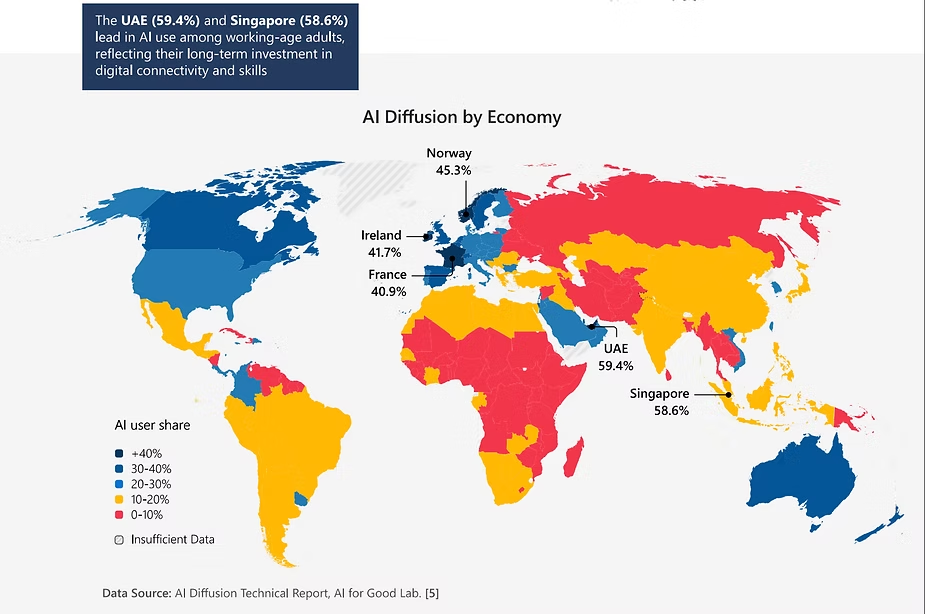
Key Findings from the Report
- AI reached 1.2 billion users in under three years, faster than any previous technology.
- AI usage in the Global North is nearly twice that of the Global South.
- The United States and China host 86% of global data center capacity, highlighting how concentrated AI infrastructure remains.
- Language barriers significantly limit adoption, especially in regions dominated by low-resource languages.
- Countries like Singapore, the UAE, and Norway show how strong digital infrastructure and coordinated policy can accelerate adoption.
- Access to education, connectivity, and inclusion is critical to ensuring AI benefits are shared more broadly.
Two Stories Hidden in the Same Numbers
At first glance, the adoption figures are impressive. No technology in history has reached a billion users so quickly. But a closer look reveals a second, less optimistic story.
AI adoption is heavily concentrated in regions with reliable electricity, strong internet infrastructure, and widely supported languages. Nearly half the world still lacks one or more of these essentials. Even when internet access exists, language can be a major barrier. For example, Swahili, spoken by more than 200 million people, has roughly 500 times less online content than German. As a result, AI tools often perform poorly or not at all for users in these languages.
This means that access to AI is shaped not just by technology, but by geography, infrastructure, and cultural representation.
Innovation Is Global Infrastructure Is Not
The report also highlights a growing imbalance between AI development and AI deployment. The competition to build advanced AI models has become increasingly global. China is now only about six months behind the United States in model performance, and the gap continues to narrow. More countries are gaining the expertise to develop competitive AI systems. However, running these models at scale requires enormous computing power. Data centers, energy supply, and cloud infrastructure remain heavily concentrated, with 86% located in just two countries. This creates a bottleneck: innovation may be spreading, but the ability to deploy AI widely is not keeping pace.
The Challenge of Reaching the Next Billion
The report does not argue for a specific policy solution, but it raises an important question. If the first billion AI users arrived so quickly, what will it take to reach the next billion?
The answer likely lies beyond better models alone. Expanding AI’s reach will depend on:
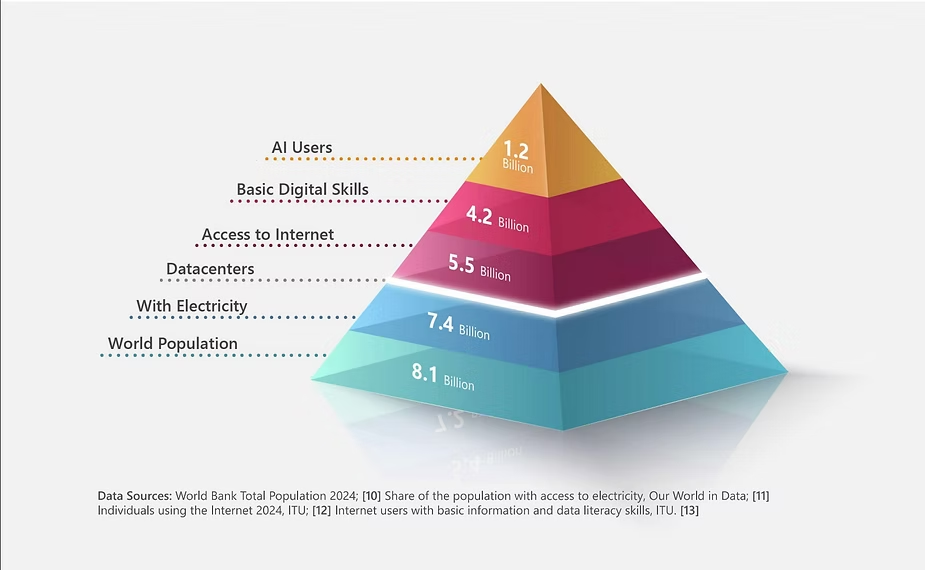
- Improving electricity and internet access
- Investing in local-language data and tools
- Building digital skills through education
- Creating inclusive policies that support broader participation
Without these foundations, AI risks deepening existing inequalities rather than closing them.
Microsoft’s AI Diffusion Report makes one thing clear: AI’s rapid rise is real, but so is the divide it exposes. The technology is moving fast but not everyone is moving with it. As AI continues to shape economies and societies, the challenge ahead is not just innovation, but inclusion. How the world responds now will determine whether AI becomes a shared global resource or a force that benefits only a few.
More information: visit here




GIPHY App Key not set. Please check settings